The Sovereignty of the Click: How Pix Liberated Brazil from Financial Intermediaries
Pix Brazil revolutionized instant payments in the country, eliminating financial intermediaries and guaranteeing economic autonomy for millions of Brazilians. Learn how this public system transformed money transfers.
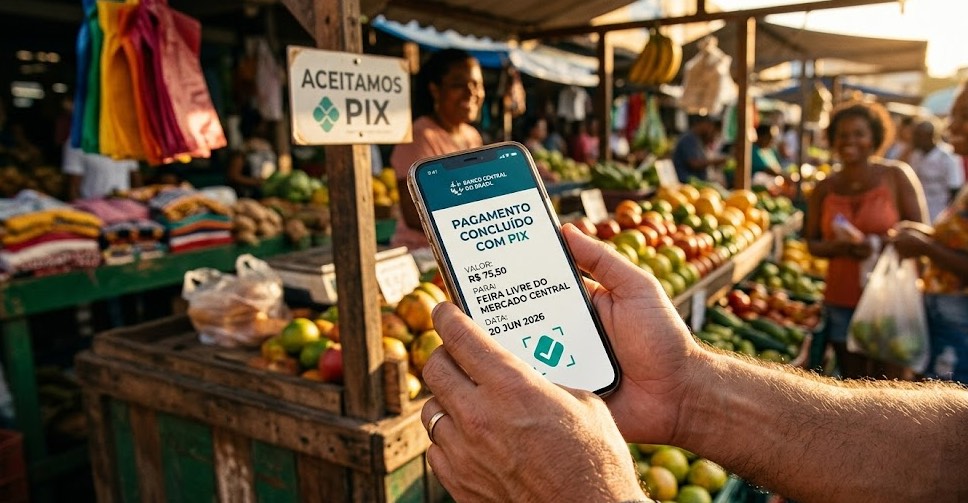
If you go to a beach in Rio de Janeiro to buy coconut water, the street vendor won’t ask you for cash or pull out a traditional credit card terminal. Instead, they will show you a small sign with a QR code. In three seconds, using your phone, the money will transfer from your account to theirs—with no fee for individuals under the conditions provided by the regulations.
This isn’t magic; it is Pix, the instant payment system created and managed by the Central Bank of Brazil (BCB). Launched in late 2020, Pix has become the country’s most widely used payment method, adopted by $76.4\%$ of the population and accumulating more than $181.6$ billion transactions since its launch. According to official data published by the monetary authority in June 2026, during the month of May of that year alone, Pix mobilized a historic figure of $1.813$ trillion Brazilian reais (approximately $330$ billion dollars) through $6.311$ billion individual operations.
Why is Pix a revolution that goes beyond technology? Because it is a declaration of financial autonomy.
The Power of Independence (Goodbye, Card Networks)
To understand the success of Pix, one must understand how the traditional system works. When you pay with a conventional debit or credit card, your money travels through a complex highway controlled by private international corporations (the “rails” of Visa, Mastercard, or American Express) and local processors. Each of them takes a cut of the transaction in the form of fees, and merchants sometimes have to wait days to see their money.
Pix changed the rules of the game by building its own rails. The system does not depend on external intermediaries or the infrastructure of global credit card brands. It is a public instant payment network operated directly by the Brazilian Central Bank.
The advantages of this independence are devastating:
- Instant Settlement: Money is transferred in less than two seconds, 24 hours a day, 7 days a week.
- No Fees for Individuals: Transferring and using the service generally has no cost for individuals under the conditions and limits established by the BCB’s general regulations.
- Minimal Fees for Businesses: Merchants pay a fraction of what it would cost them to accept a traditional card, eliminating the need for expensive physical point-of-sale (POS) terminals.
Continuous Evolution: Contactless Pix and Anti-Fraud Shielding on the Regulatory Calendar
Far from stagnating, the system continues to evolve to eat away at physical plastic’s market share, although with very clear deadlines set by the regulator. In June 2026, the Central Bank of Brazil published Normative Instruction 746, which significantly eases the rules of “contactless Pix” (payment via digital wallets using NFC technology) by eliminating the standard daily limit of $500$ reais. According to the official calendar, this relaxation will take effect on October 1, 2026, the deadline for financial institutions to adapt their IT systems and allow users to customize their own daily security caps directly from their banking apps.
Likewise, the security of the ecosystem is being strengthened through the transition toward the MED 2.0 (Special Refund Mechanism) standard. This evolution of the original mechanism—whose initial optional phase for institutions began in late November 2025—empowers banks to automatically track the path of fraudulent money through multiple levels of receiving accounts, rather than just the first destination account. By quickly blocking the dispersion of illicit funds, the BCB and the financial sector aim to considerably increase the recovery rate of assets lost to virtual scams.
Why Is This a Lesson in Sovereignty for Latin America?
The beauty of Pix lies in its democratic approach. While cryptocurrencies promised to decentralize money but remained in the realm of speculation, and private banking apps often segregate those without a formal credit history, Pix was born from the base of the social pyramid. It succeeded in banking millions of people who previously relied exclusively on cash.
For Webi.lat, the case of Pix proves that governments in our region do not need to wait for technological solutions to come from Silicon Valley or Wall Street. When the State takes an active role in the innovation of public digital infrastructure, it is capable of creating tools that are more efficient, sovereign, and secure than those of the private market.
Webi’s Verdict
Pix is not just a technological success; it is an example of how digital sovereignty can directly improve the daily lives of millions of people. While other countries in the region advance at a slow pace with fragmented payment systems, Brazil has already proven that the future of money is public, instant, and completely independent of traditional financial networks.
Sources for Further Research:
- Banco Central do Brasil (BCB): Monthly transaction statistics for Pix and press releases on payment Normative Instructions.
- Folha de S.Paulo / Mercado: Regulatory analysis on Normative Instruction 746 for contactless Pix and its implementation deadlines for October 2026.
- Convergência Digital: Reports on financial volume statistics and telecommunications updates associated with Pix for mid-2026.
Leave a Reply