The Trickster Trap: Why Netflix’s “México 86” Sugars Up Corruption Under the Guise of “Cleverness”
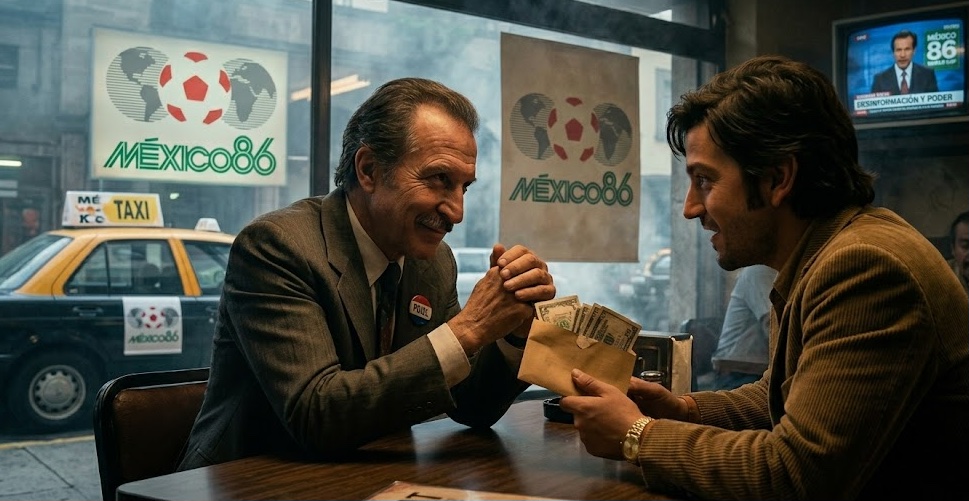
With the 2026 World Cup currently underway, Netflix didn’t miss the opportunity to tap into soccer nostalgia with “México 86”, a tragicomedy directed by Gabriel Ripstein and starring Diego Luna. The premise seemed unbeatable: to uncover the backroom deals of how Mexico landed the host status for the 1986 World Cup after Colombia backed out, exposing the political negotiations, FIFA’s interests, and the sheer power of Televisa.
However, the result is disappointing for anyone looking for a serious anatomy of power. Instead of a sharp critique of the system that left us with the legacy of the 1980s crisis, the film falls into one of the worst habits of Mexican national cinema: romanticism disguised as satire, where corruption is pardoned as long as it’s packaged with charisma.
Martín de la Torre: The Lovable Rogue We Do Not Need
The protagonist, Martín de la Torre (a fictional and highly charismatic Diego Luna), is built on the classic Latin American archetype of the “lovable rogue” (el macho pícaro). He is unfaithful, cheats, has gambling debts, and manipulates whoever is necessary to get his way. Yet, Ripstein’s direction tries so hard to make him “human” and “likeable” that it distracts from the real issue.
By centering the narrative on Martín’s individual audacity—like when he switches seat names at the FIFA vote to trick the delegates—the film reduces structural corruption to a mere anecdote of cleverness. Corruption is not shown as a deep social wound that perpetuates inequality, but rather as a superpower that only Mexicans possess: the art of “knowing how to get ahead at the expense of others.”
“El Tigre” Azcárraga and the Mythologizing of Monopoly
One of the weakest points of the script by Ripstein and Daniel Krauze is its portrayal of de facto power. Daniel Giménez Cacho plays Emilio “El Tigre” Azcárraga as a sort of imposing, cynical, yet admirable patriarch. In the film, the owner of Televisa is depicted almost as a nationalist hero who, through his virtually unlimited influence, “puts Mexico on the map.”
This aesthetic and narrative choice is dangerous. In the 1980s, the complicity between the television monopoly and the ruling party (the PRI) was not a clever game of chess; it was a machinery of censorship and social control that silenced massacres, legitimized electoral fraud, and plunged the country into disinformation. By treating Azcárraga as a “shameful but brilliant uncle,” the film loses the chance to question the management of real power, preferring the comfort of cheap jokes about the era’s masculinity.
"Martín, in some way, personifies Mexico. We Mexicans are lovable, fun, and party-loving, and we also have a dark side..."
— Gabriel Ripstein, director of the film.
This very quote from the director reveals the bias of the work: equating a “party” with institutionalized crime. No, Mr. Ripstein—forging documents, embezzling public funds, and rigging bidding processes is not being “lovable and tricky”; it is a crime that devastated the social fabric of the country.
The “Cachirulazo” as a Misstep, Not a System
The film uses the famous “Cachirules” scandal of 1988 (where the Mexican National Team fielded overage players in a youth tournament) as the dramatic climax and Martín’s downfall. But even here, the script treats it as an individual miscalculation, an ambition that simply “crossed the line.”
It systematically ignores the fact that the “Cachirulazo” was not an exception, but the rule of a sports and political system rotten to the core. By failing to dig deeper into the complicity of government authorities and the real impact these maneuvers had on a Mexican society that, in 1985, had just suffered a devastating earthquake and was living through a brutal economic crisis, the film feels empty. It is an 80s party washed in synthesizers that prefers not to look at the ruins outside.
Webi’s Verdict
“México 86” works incredibly well as light entertainment and as a piece of production design nostalgia. Diego Luna’s performance is magnetic, and the pacing never drags. But as a piece of social commentary, it falls short.
The movie ends up legitimizing the idea that corruption is part of our “cultural DNA”—a necessary evil that, at the end of the day, gifted us Manuel Negrete’s legendary goal and the consecration of Diego Maradona. At Webi, we believe it is long past time to stop applauding the trickster on the big screen. “Mexican cleverness” deserves better stories than those that only serve to justify our worst villains.
Webi Rating: 2.5 / 5 stars (Great packaging, zero self-critique).
Webi Fact: The real culprit behind the “Cachirules” scandal, Gerardo Gallegos (on whom Martín’s character is loosely based), never spent a single day in jail nor faced major legal consequences. He continued working in national sports and politics for decades, proving that in the real Mexico, impunity does not have a Netflix-style movie ending.
Leave a Reply