The Scar that United the World: Why Watching “Historias del Canal” is Essential to Understand Panama
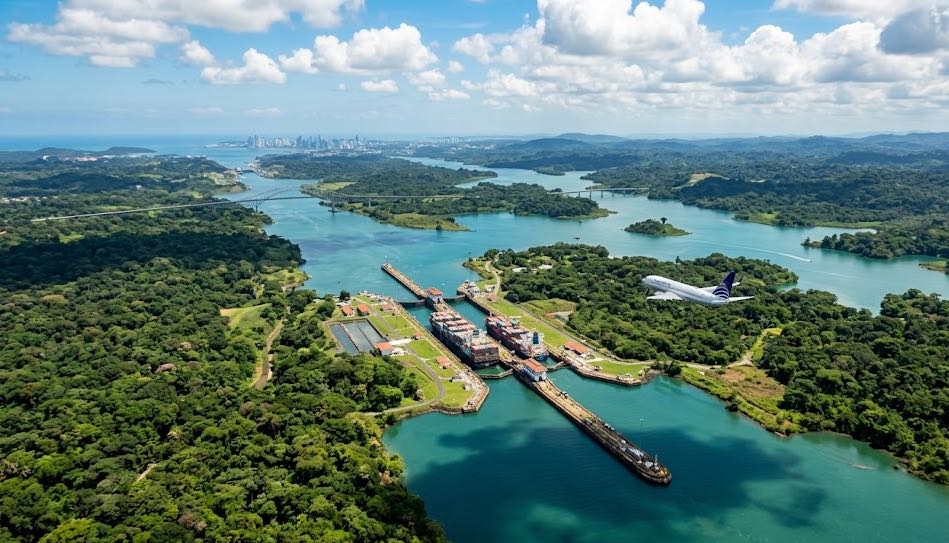
The Panama Canal is not just an engineering miracle or a shipping lane that moves a vital portion of global maritime trade. It is, above all, a scar. A wound that divided a country in two for nearly a century to unite the oceans. Recently, during a flight with Copa Airlines, I stopped to watch the film Historias del Canal (2014) and found the best visual tool to understand why Panama cannot be explained without its struggle for sovereignty.
The film, divided into five stories spanning from 1913 to 2013, shows us that the Canal has been the axis upon which the identity of an entire people has been built (and sometimes destroyed).
It Wasn’t Just Engineering; It Was a Tower of Babel
The construction of the Canal is often sold as an exclusively American feat, but the film begins by reminding us that the concrete of the locks was mixed with the sweat of massive and diverse immigration. In 1913, the isthmus was a melting pot of workers arriving from Barbados, Jamaica, China, Spain, and Italy.
These were people looking for a future who ended up building someone else’s under a caste system. The film unflinchingly describes the reality of the time: the “Silver Roll” and the “Gold Roll”. A segregation system where the value of your life, your salary, and your food depended on your skin color and origin.
In the fiction, it is mentioned that the Zone operated under “Louisiana laws,” alluding to that imported legal framework from the United States that allowed and normalized racial segregation. In practice, the Canal Zone functioned as a federal territory with its own government and laws—a foreign enclave embedded in the heart of the tropics where Panamanians were, ironically, second-class citizens.
1964: The Day the Students Became Heroes
If there is a moment in the film that helps you understand this country’s psychology, it is the story set in 1964. Here, the spark that changed everything is narrated: the feat of the students from the Instituto Nacional.
The context is powerful: a group of young people marched toward the school in the Canal Zone with a claim that seems simple today but was subversive then: they wanted to hoist the Panamanian flag alongside the United States flag, as dictated by the agreements of the time that the “Zonians” refused to fulfill. The response was violent, the flag ended up torn, and the conflict escalated into a confrontation that left a toll of 21 Panamanian martyrs.
That event, portrayed with great rawness in the film, was the point of no return. It was the moment when Panamanian identity stopped being an abstract idea and became a physical struggle for total independence. Without that January 9th, the Panama we know today would not exist.
A Country Crossed by Intervention
Through the 50s, 70s, and into the present, the film shows us how foreign intervention marked every aspect of daily life. From espionage to the complex political negotiations of the Torrijos-Carter Treaties, the Canal appears as a shadow that defined the fate of Panamanian families.
It is fascinating to see how the film connects those historical struggles with modern Panama—the one of skyscrapers and the regional logistics center. It reminds us that sovereignty was not a gift of diplomacy but the result of decades of pressure and resistance from a people who refused to be spectators in their own land.
Why You Have to See It
If you move through the region and want to understand why Latin American countries are so protective of our autonomy, Historias del Canal is mandatory. It is not just national cinema; it is a visual description of resistance against intervention.
Watching it allows you to understand that when a Panamanian looks at the Canal today, they don’t just see locks and technology; they see the place where their ancestors were discriminated against and where their students gave their lives for the basic right to hoist a piece of tricolor fabric on their own soil.
To Dig Deeper: Official and Academic Sources
If you want to verify the facts narrated in the film, here are key sources:
- Panama Interoceanic Canal Museum: The leading institution in preserving the historical memory of the isthmus.
- National Library of Panama (Digital Collection): You can consult historical archives and newspapers from the time regarding the events of January 9, 1964.
- Panama Canal Authority (History Section): The official ACP site offers a detailed chronological tour.
- Essays on the “Silver and Gold Roll”: To understand racial and labor segregation, look for the works of Panamanian sociologist Gerardo Maloney, an expert on the Afro-Antillean presence in Panama.
Webi Tip: If you travel to Panama, don’t just settle for the photo of the locks. Visit the Martyrs’ Monument near Ancon Hill. Your perspective will change completely when you know that every corner of that area was, for decades, a forbidden border for Panamanians themselves.
Leave a Reply